 +
+
In September 2026, a public TikTok Shop store may look like a ready-made category answer: sales are high, the catalog is active, and creators appear involved. For a US seller, that record is a lead, not a product strategy. This notebook separates a shop total from the narrower product, creator, and offer questions it cannot answer.
Use a shop record to decide where to look next. Do not use it to decide what product, creator, or offer to copy. Split the public facts from the inferences you are tempted to make, then choose one product-level or content-level question that the record can actually support.
A shop total compresses many moving parts into one attractive result. A mixed catalog may include different price points, different buyer jobs, seasonal items, creator-led offers, and products with unrelated conversion paths. The total can be real. It does not tell you which component drove it. That is the central problem with using public shop performance as a copying signal. TikTok Shop seller analytics is most useful when it keeps that shop-level boundary visible.
Think about the question you are really asking. “Should we enter this category?” is not answered by a shop’s total volume. “Should we copy this product’s offer?” is not answered by the same total. “Should we work with creators?” is not answered by a count of influencers. Each question needs a unit that matches it. The shop record may help you find a product or content lane worth inspecting. It cannot collapse those separate reviews into one conclusion.
The habit to avoid is false transfer. A team sees a shop moving volume and quietly assumes the category is healthy, the products are comparable, the creators are responsible, and the offer will travel. Those are four claims. A public total may support none of them without further work.
| Observed public field | What it can support | What it cannot support |
|---|---|---|
| 29 products | The catalog is mixed enough to require product-level separation | Which product drove the observed volume |
| 81,700 30-day sales volume | A reason to inspect the shop record more closely | Margin, category demand, or future sales |
| $91.40 average price | A broad price-context note for this one record | Comparable pricing for your product |
| 16 influencers and 24 videos | Public evidence that creator and video activity existed | Creator terms, attribution, or causal performance |
Scope: one dated public shop record used as a lead. Market: US. Access date: September 8, 2026. Sample: one mixed-catalog shop record. Cleaning: separate the catalog, product, and content before comparison. Limit: it is not a category benchmark and does not show margin, private traffic, terms, or causality.
The U.S. Census Bureau’s e-commerce releases publish aggregate estimates with a stated period and methodology. One public shop record needs the same discipline: retain its date and scope, then avoid treating it as a market-wide measure.
The important detail is not the largest field. It is the mixed catalog. Twenty-nine products make the shop total less portable, not more. The result can still be valuable: it tells you that there is enough activity to choose a precise next question. It does not tell you which item deserves your inventory plan.
Write the shop fact in one column and the inference in the next. “The shop has 81,700 30-day sales volume” is a retained fact. “This category will sell for us” is an inference. “The shop lists 16 influencers” is a retained fact. “Influencers caused the shop’s sales” is an inference. The distance between the columns is the research plan.
Now ask whether the inference could remain true if one detail changed. If the top-selling product were a different category, could the shop still have the same total? Yes. If the creators were paid on terms you cannot see, could their apparent activity mean something different for your own plan? Yes. If the average price hid a high-priced product and many low-priced add-ons, could it fail as a comparable price anchor? Yes. If the answer is yes, the shop total cannot carry the conclusion.
This test is not an argument for ignoring public shop data. It is a way to use it without assigning it a causal role it has not earned. A public record becomes more useful when the team can state the first inference it refuses to make.
Register for KOLSprite and claim a three-day trial of the web product. MCP access is sold separately.
Register and claim a three-day trial
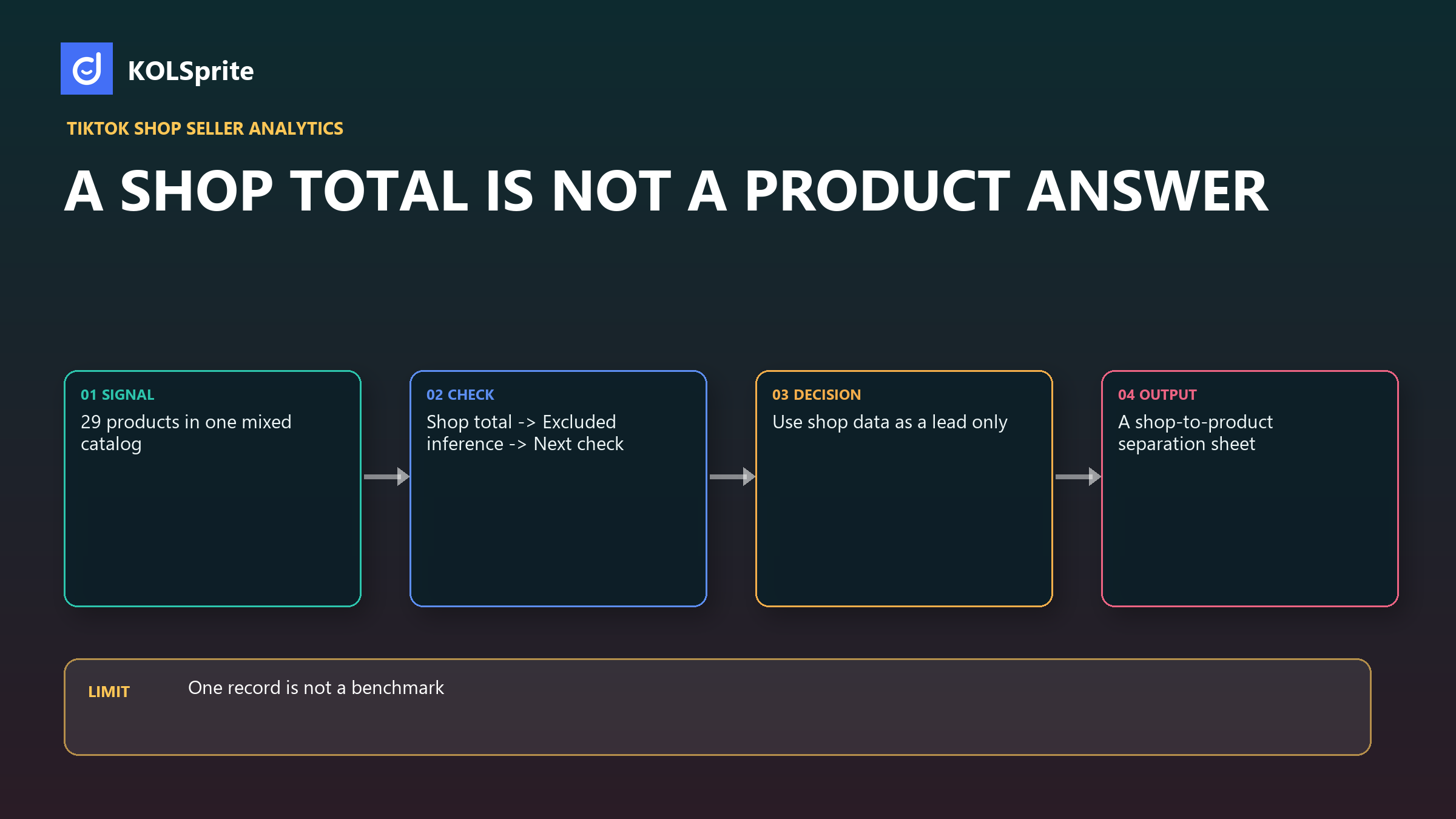
The separation sheet has four rows: retained shop facts, excluded inferences, the next narrow check, and the decision that check could change. Start with the data you can name. Then list every attractive claim you cannot establish from the record. This is where teams often discover that they are asking for a product answer from a shop-level field.
For the next narrow check, choose one lane. A product lane might ask: Which visible item has a buyer job and price band close enough to our proposed offer to compare? A content lane might ask: What does a small, dated set of public videos show about how that product is explained? A creator lane might ask: Is there enough public context to understand the creator’s content role without guessing at terms or attribution? Pick one. The sheet becomes vague when it tries to review the entire shop at once.
The final box is the decision. “Open a product-level comparison” is a decision. “Research more” is not. A good sheet says what the next check could change: whether to shortlist a product, pause a category idea, or draft a narrow content hypothesis. The resulting work has an owner and a stopping point.
KOLSprite MCP can return a scoped public shop record that gives a team a concrete lead. Enter the exact public shop ID and the product-level question you want to answer. Separate the record’s totals from the product and content questions that follow. The resulting sheet should preserve the facts, exclude unsupported inferences, name one next check, and carry the limitation beside the recommendation.
Input: one exact public shop ID and a product-level question. Action: use KOLSprite MCP shop search for the bounded shop record, then split the returned totals from product and content questions. Output: a shop-to-product separation sheet with retained facts, excluded inferences, a next check, and a clear limit.
TikTok Shop seller analytics can support that first, scoped shop review. The separation sheet keeps the output useful for a product or content decision without turning the record into a category conclusion.
One shop record is not a category benchmark and does not show product-level margin, private traffic, creator terms, or causal performance. Public fields should not be turned into a claim about why the shop succeeded.
When the sheet identifies a legitimate product lane, use a product-level comparison rather than returning to the shop total. The unit of research should match the unit of the decision. That is how a public shop record moves from an interesting number to a bounded commercial question.
Write down why the record was selected
Teams often keep a shop record because it looks impressive, then forget why it entered the research queue. Add a short selection note to the separation sheet: the public field that caught attention, the US market label, the date checked, and the narrow question it can support. This protects the record from gradually becoming a generic example of success.
TikTok Shop seller analytics should preserve the distinction between a returned shop field and the product question a seller wants to answer. That distinction is what keeps a useful observation from becoming a copied strategy.
The note also helps when the record changes. Public fields may update, product mixes may shift, and visible creator activity may not represent the same period as the total. When a later reviewer sees the original selection note, they can decide whether the record still fits the question or whether it needs to be retired. That is ordinary research hygiene, not a claim that public data remains stable.
A shop total is most useful when it is treated as dated and scoped. The moment it loses those labels, it starts to invite claims about a category, an offer, or a creator model that the record never measured.
There is a second benefit to recording the selection reason. It makes the team look for disconfirming evidence early. If the shop was chosen because a category seemed adjacent, ask which products in the catalog actually make it adjacent. If that answer is weak, the record can leave the queue without becoming an unofficial benchmark for the project.
That is a useful outcome. Good market research removes weak leads quickly, so the team can spend its time on the one question that can still change a commercial decision.
Keep the sheet with the dated record, not with a generic category folder. A reader should be able to trace the lead back to the exact public shop observation and see the boundary that stopped the team from treating it as a market-wide conclusion.
That traceability matters when the launch plan changes. It lets the team retire an old lead instead of quietly carrying its total into a different product discussion.
Join the KOLSprite Discord to discuss the question behind your next test.
 +
+
Join the KOLSprite Discord community
Creator and video counts are especially easy to overread. Sixteen influencers and 24 videos tell you that public activity existed in the returned record. They do not identify a creator’s compensation, posting requirements, content quality, sales contribution, or audience fit. A team that wants to learn from activity should sample specific public content and write down what it can observe, not use the count as a proxy for a partnership plan.
The same applies to offer design. A shop’s average price is context, not a recommended price. It says something about the record’s broad mix. It does not show discounting, bundles, shipping treatment, or the relationship between a particular product and its buyer. Put price in the separation sheet as a field to inspect, then refuse to use it as a standalone transfer rule.
When the next question is about buyer fit, use the buyer-expectation review alongside the product comparison. It keeps the shop total from substituting for the buyer job that still needs evidence.
The best outcome from a strong shop record is usually a smaller question. You might discover one product format worth comparing, one content pattern worth observing, or one category promise that clearly does not transfer. Each is more useful than a broad instruction to copy the shop.
Use the order-margin context when the team starts treating a public total as a final answer. It restores the labels around the number: object, period, market, comparison rule, and missing context. That is the discipline that keeps a notebook from becoming a confidence exercise.
Before the next meeting ends, point to one product-level or content-level question that survived the separation sheet. State the public fact that led to it, the inference you rejected, and the evidence you need next. The record has then done its job. It created a focused lead without pretending to be a benchmark.
That boundary is valuable even when the answer is to stop. A mixed shop total may be too broad to support your buyer, product, or offer. Rejecting a weak transfer saves time because it prevents the team from building a research plan around a conclusion that the data never contained.
Latest Articles

As an essential, data-driven toolkit for TikTok influencers and marketers, KOLSprite provides powerful features for effortless creator discovery, trending content identification, and actionable real-time insights.
It empowers users to make smarter decisions and significantly boosts their TikTok business.

 Refer & Earn