 +
+
One repeated TikTok question can prompt a team to fix the product, rewrite the listing, and plan a new video at once. The rush makes sense. But a buyer question is not a diagnosis. This article helps US online sales and content teams decide what to do next. The right move may be a product change, a clearer explanation, more proof, or no change.
A repeated question is a reason to study the hope or concern behind it. It is not proof that the product is wrong. Save the exact words. Name the buyer's expectation. Check the sample. Then choose the smallest action that the evidence supports.
Comment areas are noisy, fast, and unusually tempting. A seller sees several people asking whether an item fits a laptop, works on a particular skin type, or includes a certain accessory. The group may seem to be telling the team what to change. It may be showing that the video skipped an explanation. It may be showing that a popular comment pulled in people who are not the target buyer at all.
Copy one question exactly before you interpret it. Do not rewrite “Will this hold a 16-inch laptop?” as “The bag is too small.” The first sentence is a buyer question. The second is a product claim that the buyer did not make. This small discipline prevents a team from converting an information gap into a product defect before it has looked at the original context.
Then ask what expectation sits underneath the words. A fit question may point to a size expectation. A “does it come with” question may point to an unclear bundle. A “how do you use this” question may point to a missing demonstration. The expectation gives the team something concrete to inspect. It does not give the team permission to invent why a buyer asked.
TikTok comment analysis begins with preserving the buyer’s wording. A useful review can group discussion, but it should not quietly replace a question with a conclusion.
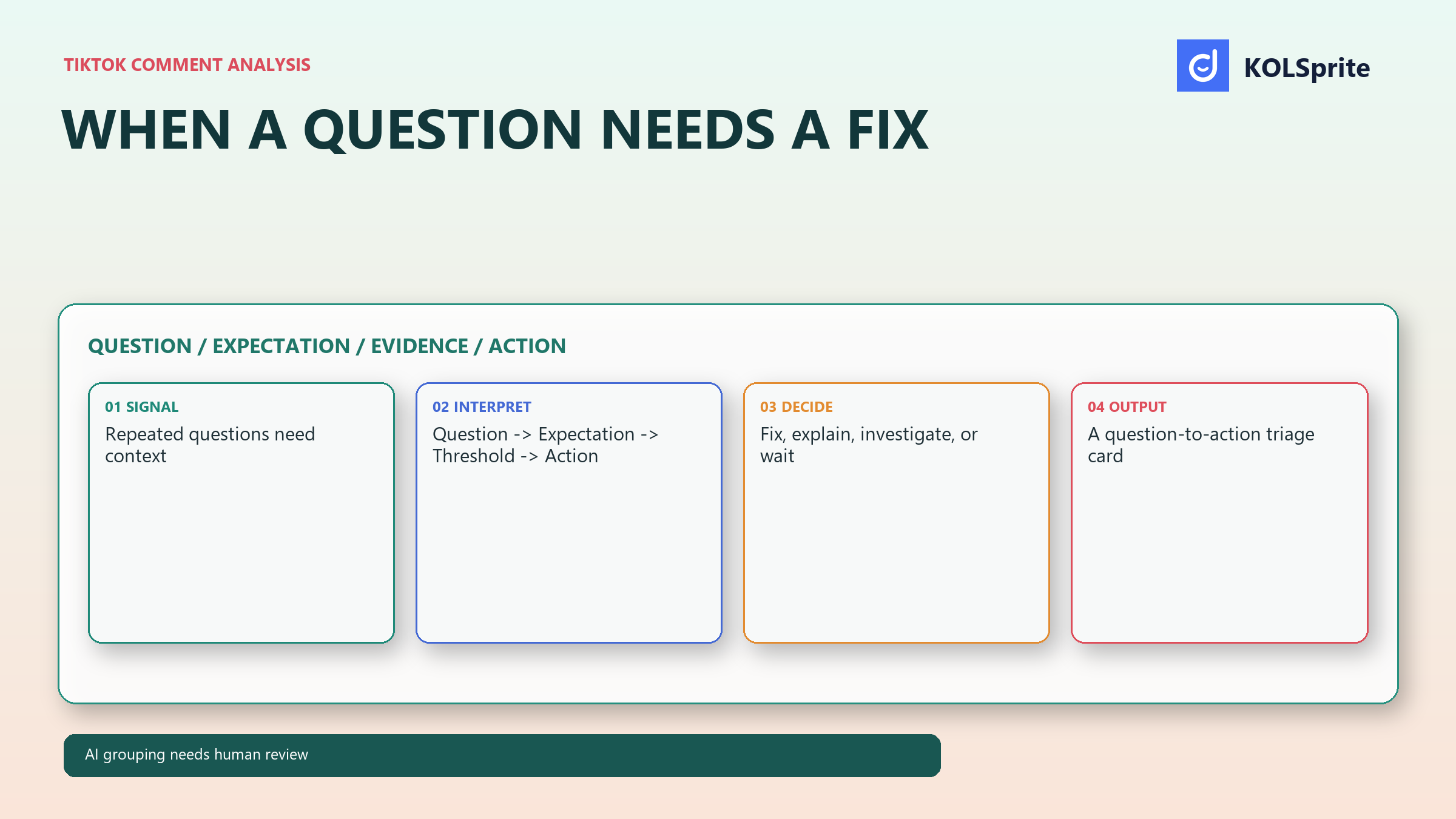
Use four action lanes: explain, investigate, change, and leave alone. An explain lane fits when the product may already meet the expectation but the listing or video has not made that clear. An investigate lane fits when the question could expose a product or claim issue, but the available comments are too thin or mixed to tell. A change lane fits only after the team has product evidence for a change. A leave alone lane fits when the question comes from an audience outside the intended product promise or from a misunderstanding the team should not turn into a new promise.
These lanes avoid a false choice: ignore every comment or change everything. A content team can add a clear demo without saying the product has changed. A product team can study a possible issue without treating one thread as proof of poor quality. The response should match the evidence, not the team's level of concern.
Ask a second person to sort the question before they see the proposed action. If both people name the same expectation, move on to the evidence. If they disagree, put the question in the investigation lane. Record the disagreement. Do not hide it inside a firm product brief.
| What to record | What the team checks | Allowed next move |
|---|---|---|
| Exact buyer question | Words, video context, and product shown | Preserve it without rewriting the claim |
| Buyer expectation | Fit, use, bundle, safety, timing, or outcome | Name the expectation, not a diagnosis |
| Evidence threshold | Relevant sample and representative original comments | Explain or investigate |
| Chosen action | Listing, video, product review, or no change | Choose the smallest supportable action |
| Limitation | What comments cannot establish | Keep human review and product evidence in the decision |
Scope: one supported public comment area and one reviewable buyer question. Market: US use case. Access date: September 8, 2026. Sample: KOLSprite’s published comment-analysis workflow. Cleaning: return to representative original comments before action. Limit: grouped output is a research signal, not proof of demand, quality, or buyer intent.
The card is most useful when a team feels pressure to act. It puts a clear gap between a question and a product change. If no one can name the proof needed for a change, explain or study the issue first. Wait for stronger evidence before changing the product.
Register for KOLSprite and claim a three-day trial of the web product. MCP access is sold separately.
Register and claim a three-day trial
Imagine a hypothetical kitchen tool video. Several viewers ask whether the tool works with a deep pan. The team checks the product description and finds that the compatible pan depth is mentioned only in a small image. The question points to an explanation gap. The appropriate action may be a revised image, a brief demonstration, or a clearer line in the listing. It does not establish that the tool fails.
Now picture a made-up skincare video. Viewers keep asking if the product is safe for a condition the brand has never claimed to treat. The questions may show interest. They also mark a clear claim risk. The team should not hint at a use that has not been verified. Save the question and avoid the claim. Then check whether sound product evidence could support a later review. Until then, leaving the product promise as it is can be the right choice.
These examples are made up because the right action depends on the real product, claims, comments, and review. What matters is the shape of each choice. One question calls for a clearer explanation. The other marks a boundary. Neither lets a team turn a comment pattern into customer proof.
KOLSprite AI Comment Analysis can group public talk by topic, pain point, use case, purchase intent, and rival brand mention. Start with a clear prompt: “What expectation is behind this repeated fit question?” Read the grouped output. Then go back to a fair sample of the original comments before you record a decision.
For TikTok comment analysis, the human review step keeps the product and content decision accountable. Grouped themes help prioritize attention. They do not decide which claim a team can make.
The useful output is a triage card, not a product verdict made by a tool. The card holds the question, the likely expectation, the proof needed, the chosen action, and the limit. A product manager, content lead, or compliance reviewer can then see what the system found. They can also see what a person added while reading the result.
Input: one supported public TikTok comment area and one buyer question that a person can read in context. Action: run KOLSprite AI Comment Analysis, read the grouped output, and return to a fair sample of comments. Output: a triage card with the question, expectation, proof threshold, chosen action, and limit.
KOLSprite AI output cannot capture every intent or prove product demand. It cannot replace a review of culture and context. It also cannot approve a product claim without a person checking the proof. Do not use it as evidence that the product must change.
Any claim made to buyers still needs a sound basis. The FTC’s advertising guidance gives a useful outside limit. Public comments alone are not proof for a new fact-based product claim.
Join the KOLSprite Discord to discuss the question behind your next test.
 +
+
Join the KOLSprite Discord community
Comment problems get harder when content and product teams must solve the same sentence. A content lead can answer the question, show the product, set the frame, or ask for more detail. A product lead can check if the item meets the stated need and if the claim has support. The jobs are linked, but they are not the same.
When the card points to explanation, build a focused buyer-question video brief. Show the buyer condition that matters and state the limit. Do not turn the video into a list of every possible use. When the card points to investigation, give one person the job of finding the missing product proof. The public comments are still context, not the conclusion.
When it points to no change, write why. “Question falls outside the documented use case” is clearer than “not enough comments.” A future team member can then see whether new evidence changed the boundary or whether the product promise remains the same.
Teams often overreact because they believe every recurring question needs a visible response. A smaller response can be stronger. A single clearer image may answer a fit question. A product review may need to wait. A claim may need to remain off-limits. The triage card gives each decision a reason and keeps the reason next to its limit.
For the full research process, return to the comment analysis workflow. Follow the same path: inspect, group, read the original context, and decide. The work stays useful when a person can explain the final action without saying, “the tool told us to.”
After the triage card, use the KOLSprite MCP workflow only for the public research question that remains. It can help with a clear handoff. It does not replace a person's review of the original comments.
Record what would change the decision
A triage card should not end with a vague caution. Add one sentence that names the evidence that would move the question to a different lane. For an explanation gap, it might be a product specification that shows the current video is incomplete. For an investigation, it might be a relevant sample of original questions and a product review. For a claim boundary, it might be approved evidence that the team does not yet have.
This makes later review faster. A new teammate can see why the team chose a content explanation last week and what would justify reopening the product question. It also stops the same visible comment from generating a fresh debate each time it appears. The decision has a date, a scope, a limitation, and a clear condition for change.
Use a plain label for the owner: content, product, compliance, or no owner when no change is needed. Do not assign the same question to everyone. It helps to keep the team aware. But when everyone owns a vague signal, no one can explain the final choice.
Keep the card with the original content review. A later team should be able to read the question, see the lane, and know why the action was limited. This record helps when the same concern returns in new words. The team can tell a new issue from a known expectation that already has a clear boundary.
Bring one open buyer question into the next review and keep the exact words. Ask what expectation it shows. Ask what proof would change the action and who owns that work. The answer may be a video update, a product review, or no change. Each is a real choice when the limit is clear.
That discipline protects buyers as well as teams. It reduces the chance that a comment becomes an unsupported claim, a rushed product change, or a content promise that the product cannot carry. A buyer question deserves attention. It also deserves a careful answer.
Keep the limitation beside the action.
Use TikTok comment analysis to narrow the next question, then let the evidence threshold determine whether the team explains, investigates, changes, or waits.
Latest Articles
As an essential, data-driven toolkit for TikTok influencers and marketers, KOLSprite provides powerful features for effortless creator discovery, trending content identification, and actionable real-time insights.
It empowers users to make smarter decisions and significantly boosts their TikTok business.

 Refer & Earn