 +
+
When a visible TikTok Shop sales number looks like a shortcut to a product decision, a US marketplace seller still needs to label the record before comparing it. This guide shows what to write down, what to leave blank, and how to decide whether the number earns a closer product review.
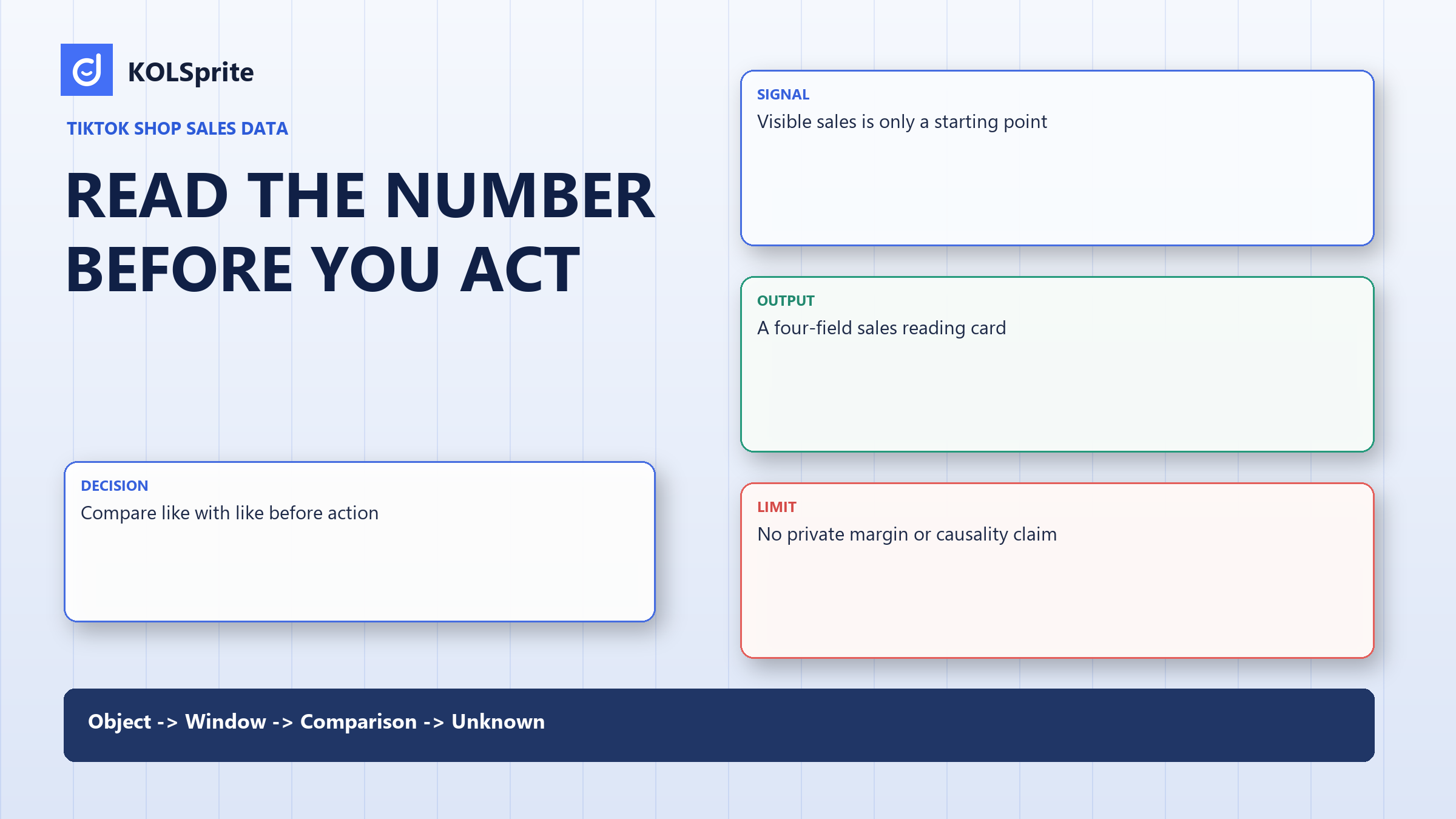
Treat the number as a field on a public record, not a verdict on demand, margin, or your next inventory order. Name the object, market, period, comparison rule, and missing context first. If those labels do not hold together, stop the comparison.
That distinction is easy to miss when a product page or shop card shows a sales figure in a large typeface. The figure may be accurate for the field it represents. It may still be useless for the decision in front of you. A shop-level total does not answer a product-level question. A recent period does not describe a full year. A US record does not make a result portable to another market, price point, or offer.
Start by saying the quiet part out loud: “This is the number I saw, and this is the decision I want it to support.” When the two sentences use different objects, the gap is the work. A seller considering a private-label product may be looking at a public shop total. A team pricing a bundle may be looking at unit sales for a single item. Neither comparison is automatically wrong. Both need a stated rule before anyone treats the number as evidence.
Search interest explains why this question keeps appearing. DataForSEO recorded 40 US monthly searches for “TikTok Shop sales data” on September 8, 2026. That is a demand signal for the topic, not proof that every public field shares the same definition. The U.S. Census Bureau’s e-commerce releases identify both reporting periods and methodology. Carry that same labeling discipline into a public TikTok record rather than leaving the period and definition implied.
Use four labels. The first is the object: product, variation, shop, category, video-linked item, or something else. The second is the period: a visible 30-day window, a lifetime total, or an unstated date range. The third is the market: confirm that the record is for the US before placing it beside a US launch plan. The fourth is the comparison rule: decide what makes another record similar enough to sit in the same discussion.
A useful comparison rule usually includes the product job, price band, buyer use case, and package size. It does not need to be perfect. It needs to be explicit enough that a teammate can challenge it. “Both are organizers” is too broad if one sells as a travel accessory and the other as a home-storage bundle. The apparent winner may be winning a different buyer moment.
This is also the point to separate sales from money. Public sales data does not reveal your landed cost, return rate, paid traffic mix, creator terms, stock position, or contribution margin. A sales field can make a product worthy of a deeper review. It cannot tell you what remains after fees and costs. For that separate decision, compare it with your own cost context, not with a public top-line number alone.
Register for KOLSprite and claim a three-day trial of the web product. MCP access is sold separately.
Register and claim a three-day trial
| Field | Write down | Do not infer yet |
|---|---|---|
| Object | Exact product, shop, or category named by the record | That every item in a shop drove the total |
| Period | Displayed window and date checked | Future demand or annual volume |
| Market | US only when the source labels it that way | Transfer to another region or channel |
| Comparison rule | Buyer job, price band, package, and use case | Margin, conversion, or product fit |
| Unknowns | Traffic source, costs, stock, variants, and attribution | That missing data is favorable |
Scope: one clearly labeled public record. Market: US. Access date: September 8, 2026. Sample: one dated search-demand observation and one visible record field. Cleaning: label the object, time window, and comparison rule before use. Limit: the field lacks cost, traffic, and buyer context for a product decision.
The card works because it makes a pause defensible. A buyer or manager may want a quick answer. You can show exactly what the number supports today: a reason to inspect a comparable record. You can also show what would be invented if the team acted as if it supported more. That is better than adding a vague warning after the fact.
Once the card is filled out, the next move should follow the biggest unknown. If the object is unclear, find a product-level record before discussing demand. If the time window is unclear, do not build a forecast. If the comparison rule is weak, review the buyer job and package promise. If cost is the missing field, do a margin review. The number itself does not choose the next task; the missing context does.
For a seller assessing adjacent products, an honest next step may be a comparison set rather than a purchase order. Put the public record beside two or three products that solve the same buyer problem, then note price, format, visible offer, and content context. The goal is to narrow the question. “Should we copy this?” is too broad. “Does this package solve the same buyer job at a similar price?” can be researched.
Use KOLSprite web research as the public-record workspace in that narrower review. Keep the displayed record, market label, and time field together while you inspect what is actually public. The output should be a sourced field card with an object, period, comparison rule, and explicit unknowns. That makes the handoff easier for the person who owns deeper research.
TikTok Shop sales data is useful when the public record and the decision use the same unit. That test catches weak comparisons before a seller starts defending them.
Input: a public product or shop record with its displayed sales field, market, and period label. Action: inspect the stated public record in KOLSprite web research and keep it separate from private commercial data. Output: a sourced field card that shows what can be compared and what remains unknown.
KOLSprite does not verify private margin, inventory, ad spend, attribution, or future sales. Displayed field definitions can vary, so a public number needs its own source and period check before it is used.
Try a sentence that forces the boundary into the open: “This US public product record shows a sales field for this stated period. It is comparable to our idea on these two points. We still do not know the traffic mix, margin, or whether the buyer use case matches.” That sentence is more useful than calling the product hot or cold. It tells the team what they can approve and what they cannot.
If somebody asks for a recommendation, give one tied to the card. Open a product review when the object, period, market, and comparison rule are intact. Request more evidence when one of those labels is missing but the buyer job still looks close. Stop when the record is too broad, the market is wrong, or the comparison depends on an assumption nobody can defend.
This approach may feel slower in the first ten minutes. It is usually faster than explaining a copied number after the inventory, listing, and creative plan have already started to drift apart. The right question is not whether a large number looks compelling. It is whether the record can survive one careful comparison.
Join the KOLSprite Discord to discuss the question behind your next test.
 +
+
Join the KOLSprite Discord community
KOLSprite can help a seller inspect current public commerce fields before deciding whether a deeper review is justified. That role is useful when public signals are scattered and a team needs one place to preserve the label with the observation. Its role is research support, not a private sales system or a profit calculator.
If the question needs a repeatable, structured public-record process, use the structured research workflow after the card establishes a legitimate next question. Keep the request bounded: one record, one comparison rule, and one unresolved decision. A larger query will not repair a weak premise.
Do not confuse a field with a benchmark
A benchmark asks for a stable comparison across a defined set. A public field belongs to one record, one source, and one stated period. The difference is practical. You can use the field to decide whether an item deserves attention. You cannot use it to tell a team what normal performance should be unless you have built a relevant comparison set and documented its limits.
That protects the seller from a common meeting error: placing a single impressive result beside an internal plan and calling the gap an opportunity. The gap may be price, package, traffic, seasonality, or buyer use case. Give each possible difference a place on the reading card. An unknown does not make the field useless. It tells you what question should be answered before the number is given more weight.
When you do have several records, keep the same labels on each one. Do not combine a product field, a shop field, and a category statistic in one average. Read them side by side, then decide whether they are close enough to form a comparison set. The value lies in the documented rule, because another reviewer can see why a record was retained or set aside.
When the comparison rule changes, create a new card. Do not edit the old one until it quietly answers a different question. That separation makes later review cleaner and prevents a convenient number from being carried into a decision it was never selected to inform.
A visible sales field earns attention when it is tied to the right object and period. It earns a decision only after the team can describe the comparison and name the missing evidence. That discipline turns a public number into a useful lead without asking it to carry the entire product case.
Use TikTok Shop sales data as a lead for a labeled review, then let the missing field determine whether to compare, investigate costs, or stop.
Bring one completed card to the next review. Ask one person to challenge the object, another to challenge the comparison rule, and a third to name the most expensive unknown. You do not need a large meeting or a new dashboard. You need an agreed statement of what the public record can support.
That record may lead to a product comparison, a cost review, or a decision to leave the idea alone. Each outcome is useful because it follows the evidence available instead of the excitement around a single number. The card gives the team a common language for saying, “We have a lead, not an answer.”
Latest Articles

As an essential, data-driven toolkit for TikTok influencers and marketers, KOLSprite provides powerful features for effortless creator discovery, trending content identification, and actionable real-time insights.
It empowers users to make smarter decisions and significantly boosts their TikTok business.

 Refer & Earn