 +
+
Monday's growth meeting opens with four tabs. One TikTok tool shows creators. A second shows public videos. A third has shop charts. A fourth sends a weekly report that no one owns. The team pays for all four. Yet no one can say which product angle should get the next test or who will make that call.
Choose TikTok marketing tools by the decision each one shortens: name the decision, define the evidence needed, assign the owner, and remove tools that do not change the handoff. A dashboard is useful only when it reduces uncertainty for a current action, not when it adds fields to an already crowded review.
Tool selection often starts with capability comparison: which platform has the most creators, the most filters, the most charts, or the most integrations. Those questions are secondary. Start with the decision that will cost time, money, or attention if delayed. It might be whether to test a product angle, which creators warrant review, which video pattern deserves a brief, or whether a listing needs a change before traffic is sent.
Write the decision in one sentence before listing a tool name. “Should we test this product with creators who can demonstrate a difficult setup?” is a decision. “We need better creator data” is not. The first sentence points to a bounded evidence need. The second invites every dashboard to make a claim on the budget.
The best tool is the one that makes the next decision cheaper to reverse. That standard does not mean the tool must supply every answer. It means the output gives the decision owner enough grounded information to choose a next step, record the uncertainty, and avoid repeating the same manual research.
First, what is the decision? Second, what public or first-party evidence would reduce uncertainty? Third, who receives the evidence and what action can they take? Fourth, what would happen if this tool disappeared for a month? The fourth question is uncomfortable, but it separates a useful system from a familiar tab.
For example, a small ecommerce team may need to decide whether a product needs a different creative brief. It may need public product and video examples, a record of the pattern observed, and a creative owner who can use that record. A tool that gathers those public examples into a bounded note may earn its place. A dashboard that repeats an already-known count without changing the brief may not.
The questions also expose duplicate subscriptions. Two tools may both surface public creators, but only one may be connected to the review process the partnership owner actually uses. Keeping both because their interfaces look different is not a decision reason. The team needs a clear difference in evidence or handoff.
Write an owner beside each decision. The owner is the person who can choose the next move, not the person who exports the report. A research lead may gather public examples. A growth lead may approve the test. A creative lead may change the brief. If no one can make a choice from the output, the tool has no complete handoff.
Then add a due point. It can be a launch review, a renewal date, or the day before outreach starts. The date keeps research from expanding forever. It also tells the owner when enough evidence must become a yes, no, or small test. The tool should help reach that point. It should not create a new queue of charts.
Register for KOLSprite and claim a three-day trial of the web product. MCP access is sold separately.
Register and claim a three-day trial
“Research tool,” “creator tool,” and “analytics tool” are too broad to manage a stack. Classify each product by the evidence it contributes to a named decision. A public product and video research tool may support a creative brief. A Seller Center report may support a listing or search decision. For example, TikTok Shop's current US SEO and discovery guidance directs sellers to Seller Center keyword information for listing work. A private attribution platform may be necessary for paid-media measurement. Those are different evidence types, and no single product should be assumed to replace the others.
This approach prevents category inflation. A creator-research tool can be useful without being a private analytics system. A content-observation tool can reveal public patterns without proving campaign performance. A first-party platform report can show a seller's data without explaining why a creative pattern worked. The stack becomes smaller and clearer when each boundary is stated.
Decision: Which product angle should receive a creator test?
Needed evidence: relevant public products, videos, creator formats, and a documented demonstration requirement.
Research handoff: a bounded observation note to the growth and partnership owners.
Keep rule: retain a tool when it gathers required evidence or improves the handoff in a way another kept tool does not.
Remove rule: remove or combine a tool when it creates a report with no named decision owner or action.
Every paid tool should survive a removal argument. Name the last decision it changed, the evidence it produced, and the handoff it enabled. If the answer is “we look at it sometimes,” the tool may be a reference source rather than a required system. That does not make it useless, but it changes the renewal decision.
Then look for overlap at the output level. Two subscriptions can have different feature lists yet create the same spreadsheet for the same owner. Combine them unless one produces evidence the other cannot. Conversely, do not remove a tool solely because another has a similar menu. Remove it when the team's actual decision path remains intact without it.
Use a modest review rhythm. Before a renewal or a new purchase, review the last few decisions rather than attempting to score every feature. This keeps the conversation grounded in work the team can remember. It also makes new requests easier to judge: a proposed tool needs a named decision, an evidence gap, and an owner before it joins the stack.
For each tool, write one of three calls. Keep means its output changed a recent decision and no kept tool can supply the same useful evidence. Combine means the work matters, but another tool or handoff can cover it. Remove means no owner used the output for a clear action. Name the reason. Do not hide it inside a score.
Use a short example. Tool A finds public videos that the creative owner uses in briefs, so it stays. Tool B exports the same links in a different layout, so its work can be combined. Tool C sends a shop summary, but the seller already uses first-party data for that choice. Unless Tool C adds a distinct action, it can go. This logic is easier to defend than a feature contest.
A removal does not claim that a product is bad. It says the product has no clear job in this team's current path. Save the decision date and the missing job. If the team's needs change, the tool can be reviewed again with a real question.
Join the KOLSprite Discord to discuss the question behind your next test.
 +
+
Join the KOLSprite Discord community
KOLSprite can consolidate supported public product, video, shop, and creator research. Its official pages describe the browser extension and MCP surfaces. Its web and extension workflows can support a bounded research note. MCP can be used in configured AI clients for supported calls. This helps when an owner needs public market context without rebuilding the same search in many tabs.
Choose the smallest supported KOLSprite workflow for a named question. For example, gather the public product, creator, or video evidence needed to review a product angle, write a bounded source-linked note, and hand it to the decision owner. The owner then decides whether to test, revise, or stop. Keep the note distinct from private performance reporting.
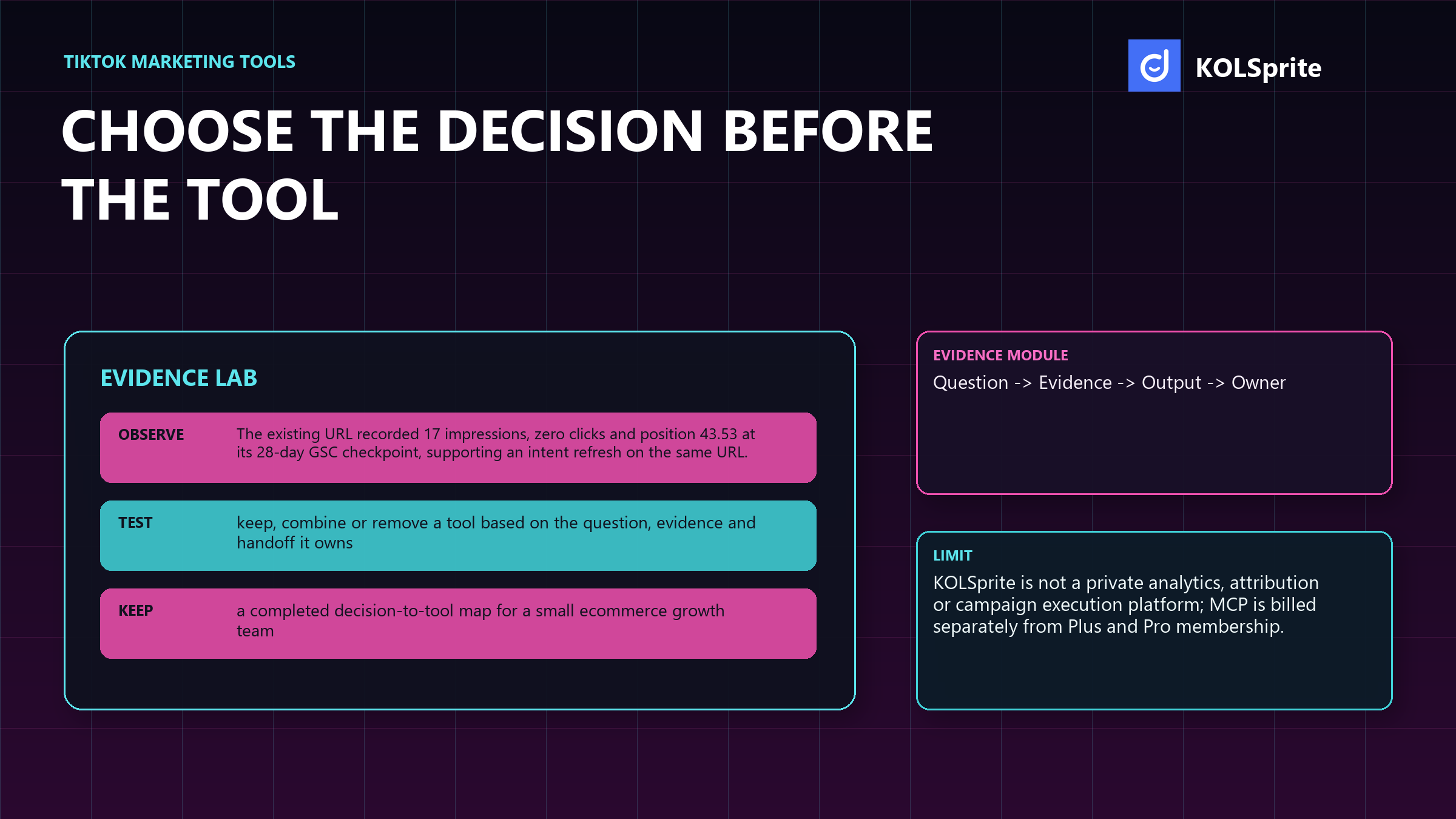
KOLSprite is not a private analytics, attribution, or campaign-execution platform. It does not guarantee outcomes or replace first-party performance data. MCP is billed separately from Plus and Pro membership and is not a free-trial benefit.
That product boundary is part of a good stack decision. It stops teams from buying a research tool to solve an attribution problem, or asking a public observation note to prove conversion. The right tool may still be KOLSprite, Seller Center, a private measurement platform, or no new tool at all. The decision determines the evidence, not the other way around.
The existing URL recorded 17 impressions, zero clicks, and an average position of 43.53 at its 28-day checkpoint: TikTok marketing tools.
Scope: the existing URL's recorded 28-day checkpoint. Market: not segmented in this compact record. Access date: September 7, 2026. Sample: one URL with 17 impressions, zero clicks, and position 43.53. Cleaning: only the recorded URL-level fields were used. Limit: the record supports an intent refresh, not a cause, ranking forecast, registration result, or revenue claim.
First-party page signals have a narrow role in a tool-stack review. They can show that a page deserves attention. They cannot decide which product a business needs. That decision still needs the four questions, the evidence boundary, and a named owner.
A tool output is complete only when someone can use it. For a product-angle decision, the handoff should name the question, the evidence reviewed, the limitation, the recommended next action, and the owner. It should not become a vague report of everything visible in a dashboard.
Here is a practical test: if a teammate receives the note without access to the tool, can they tell what decision is pending and what would change it? If not, the tool may be generating observation without operational value. Add the decision and boundary rather than another chart.
Small teams benefit most from this discipline because attention is limited. A compact note that helps a creative lead choose a test can be more valuable than a broad platform report that requires another meeting to interpret. The goal is not to reduce the number of tools for its own sake. The goal is to reduce the distance between evidence and action.
At the next review, put every tool beside one current decision. Keep it when its evidence or handoff is distinct and used. Combine it when another kept tool already supplies the same decision-ready input. Remove it when no owner can name the action it supports. This makes TikTok marketing tools easier to evaluate without pretending that one dashboard should run the whole business.
For adjacent decisions, connect your stack review to TikTok Shop analytics, assess creator-research needs through TikTok creator tools, and turn public creative observations into a TikTok video analyzer brief. Choose by the decision, keep the evidence boundary visible, and let the dashboard serve the work rather than define it.
Latest Articles
As an essential, data-driven toolkit for TikTok influencers and marketers, KOLSprite provides powerful features for effortless creator discovery, trending content identification, and actionable real-time insights.
It empowers users to make smarter decisions and significantly boosts their TikTok business.

 Refer & Earn