 +
+
A content calendar can look busy and still leave a buyer with one unanswered question. That happens when each product video is a fresh edit of the same demonstration: a hand holds the item, a creator smiles, and a caption repeats one broad benefit.
TikTok video marketing works better as a small portfolio. Commission each video to answer a different buyer question. Give it a clear proof scene, then state what the scene cannot establish on its own.
Imagine a fictional cordless milk frother campaign. The team has five videos scheduled. One shows the frother beside coffee. Another shows it from above. A third uses a different creator. A fourth adds fast cuts. A fifth swaps in an iced drink. The calendar looks varied, but every video makes the same argument: “This makes a drink foamy.”
A buyer may already believe that. The questions left behind are more useful: Is it easy to clean? Can it handle a protein shake? Is it loud in a shared office? What does it do when the milk is cold? Is it worth carrying in a travel bag? A new camera angle is not a new reason to believe.
| Official creative principle | Portfolio decision |
|---|---|
| Use TikTok-first production and a clear structure. | Choose a scene that makes sense in the feed and serves one buyer question. |
| Use sound, stimulation, and platform conventions with purpose. | Let the treatment support the proof instead of standing in for it. |
| Apply sound production basics. | Keep the claim visible, understandable, and fit for review. |
Scope: TikTok-first creative principles. Market: US audience, English-language material. Access date: September 4, 2026. Sample: one platform creative guide. Cleaning: principles separated from this article's editorial test. Limit: no universal formula or performance forecast. The Creative Codes guidance supports deliberate construction.
The source and the portfolio solve different problems. The source helps the team make a clip feel native and legible. The portfolio decides whether the clip deserves to exist beside the other four. A strong hook cannot rescue a repeated proof job. A fresh question can still fail if the scene never makes its answer visible.
Start the briefing meeting with a question, not a format. “Make a taste-test video” is a format request. “Can a buyer see whether the frother handles a cold protein drink without leaving clumps?” is a proof job. The format follows from the job. A close-up may be right for texture. A first-person morning scene may be right for routine. A side-by-side may be right for a comparison the buyer already makes.
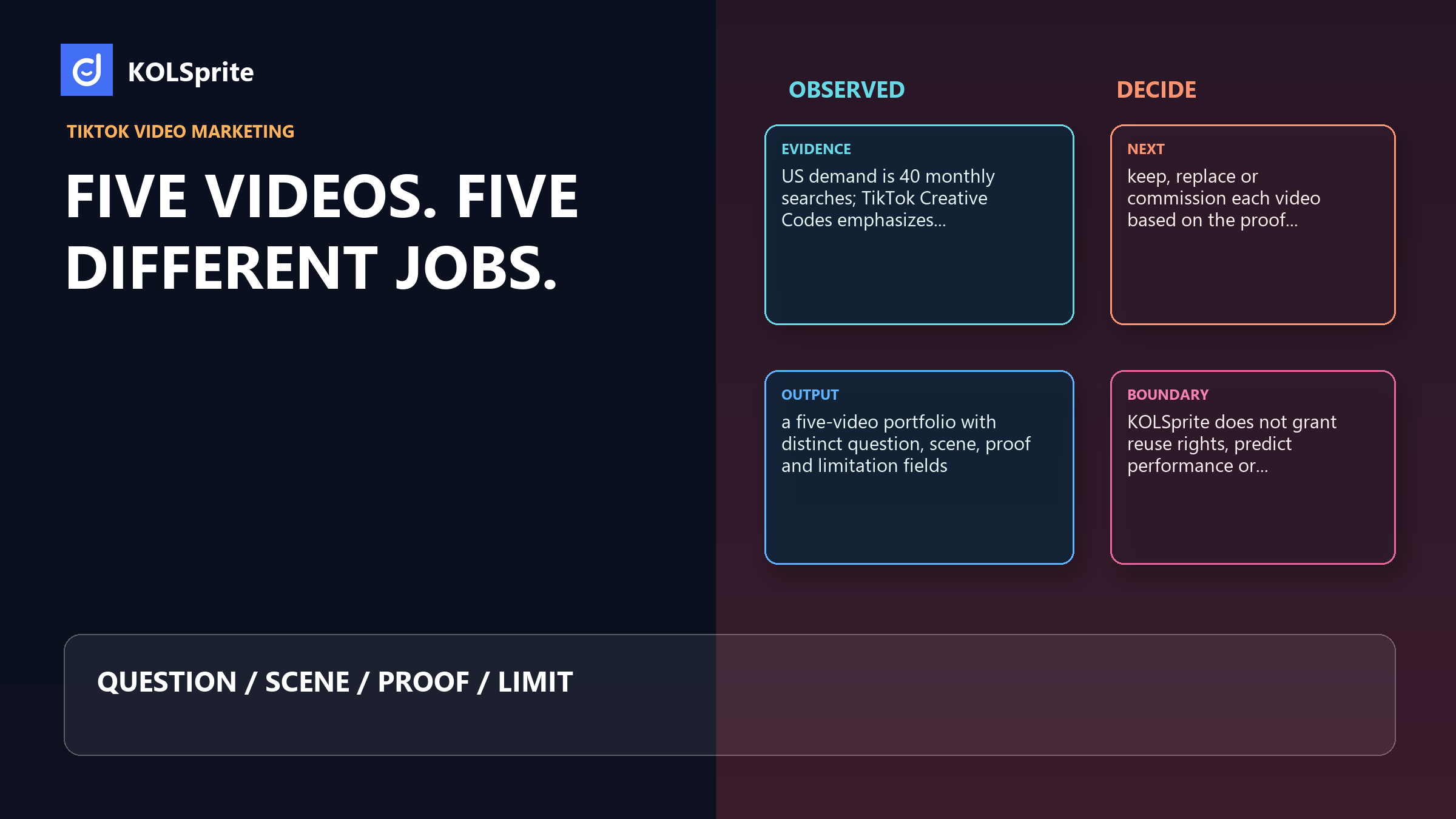
Put each planned clip through a four-part audit:
The last field matters. A video showing foam can demonstrate texture in that moment. It cannot prove long-term durability, a universal taste preference, or a future sales result. That line keeps the portfolio useful to an editor and defensible to a claim reviewer.
Give the audit a red-pencil pass. Circle the exact second when the proof appears. If the answer lives only in the caption, ask whether the scene can carry more of the work. Underline every broad claim, then replace it with a visible observation when possible. “Easy to clean” becomes a full rinse shown without a cut. The scene remains one example, so the brief must keep that limit.
Register for KOLSprite and claim a three-day trial of the web product. MCP access is sold separately.
Register and claim a three-day trial
The following briefs are original examples for the fictional cordless milk frother. They are not public performance examples or product claims. They show how a TikTok video marketing plan can make five clips do different work.
| Buyer question | Scene | Proof job | Limitation |
|---|---|---|---|
| Will it fit my rushed morning? | A 45-second desk breakfast setup | Show the sequence from cup to rinse | Does not prove every battery or cleanup experience. |
| Can it mix cold protein powder? | Clear glass, cold milk, powder added on camera | Show visible mixing and the final surface | Does not establish results for all powders. |
| Is it worth packing? | Travel pouch beside a small coffee kit | Show size and the use context | Does not prove travel rules or durability. |
| What changes in a recipe? | Before-and-after matcha preparation | Show the texture difference in one drink | Does not promise a taste outcome. |
| Will I understand the first use? | Unbox, charge, assemble, and make one drink | Remove setup uncertainty | Does not replace product instructions. |
These are not five audience segments. They are five questions that can matter to the same buyer. The portfolio is coherent because each brief adds evidence the previous one did not supply.
The five rows also create useful production contrast. The morning routine needs pace and a complete sequence. The cold-drink test needs a clear vessel and an uninterrupted view. The travel scene needs scale. The recipe clip needs a fair before-and-after setup. The first-use video needs patience. Treating each scene the same would erase the reason it was commissioned.
Before filming, add a claim owner to each row. That person confirms what the product can support and what language must stay out. The creator owns the performance. The editor owns the portfolio. The product team owns the facts. Clear ownership gives the creative room to feel natural without turning review into guesswork.
Native does not mean imitating a trend until the product disappears. It means the first seconds make sense in the feed: a visible task, a credible speaker, sound that supports the scene, and an edit that does not delay the point. The frother’s cold-protein video should open with the powder falling into milk, not with a title card that announces “the best frother.”
That choice also helps the creator. A creator can own the observation and still follow the proof job. Their voice may be dry, enthusiastic, or practical. The brief should protect the required scene and the claim boundary, while leaving room for a natural performance. For a broader system around topic, question, and format, see this TikTok content strategy guide.
Join the KOLSprite Discord to discuss the question behind your next test.
 +
+
Join the KOLSprite Discord community
Review each existing video as an editor, not a tally keeper. Keep it when it answers a buyer question no other clip answers. Replace it when it repeats a proof job but leaves a more important question untouched. Commission a new one when the portfolio has a real gap: setup, comparison, routine, objection, or outcome scene.
Suppose the calendar already has three foam shots. A fourth is not automatically bad, but it must earn its place by answering something new, such as how the frother behaves in a cold drink or how quickly a user can rinse it. If it cannot, replace it with the first-use sequence. The decision is about buyer evidence, not whether the creative looks different in a grid.
For public example review, use KOLSprite-supported video, transcript, and comment research to identify repeated proof jobs, then manually verify each original source. The output is a proof-job inventory for your own plan, not a copied creative formula.
KOLSprite can help inspect public examples, but the editor owns the idea, rights, and claim review. It does not grant reuse rights, predict performance, or replace private campaign reporting. MCP access is separate.
A useful brief tells the creator what this video must not duplicate. Add one sentence: “This clip should answer [question], not repeat the [existing proof job] video.” Then list the required scene, the substantiated claim, and the limitation. That simple contrast field prevents the common request for “something fresh,” which often produces a prettier version of the same argument.
Use the portfolio table in a review with product, legal, and creative owners. Product can flag missing facts. Legal can flag claims that need support. Creative can identify whether the scene will be watchable. No one needs to pretend that a one-minute meeting predicts performance.
End that review with one of three marks on every row. Green means the question is distinct and the proof can be filmed. Yellow means the question matters, but the scene or claim needs work. Red means another planned asset already owns the job. The colors are production status, not a forecast of views.
Public videos can show how a category frames a task, what comments repeat, or where proof looks thin. They should not become a script to reproduce. The TikTok video analyzer workflow can help a team record structure and proof jobs, while the resulting brief should remain original. When spoken language matters, a TikTok caption extractor can help locate the claims that need manual review.
Keep the line between observation and imitation visible. “Three public videos open with the product in use” is an observation. “Use their exact opening and wording” is not an editorial plan.
Before the next shoot, put the five rows on one page and read only the buyer-question column. If two rows say the same thing, give one a new assignment. If a major question has no row, that gap becomes the next commission. This changes approval from “Do we like it?” to “What does it prove?”
Hand the approved page to the producer with the green rows first. Each row should carry its question, required scene, claim owner, limit, and delivery date. The producer now has a real shot list. The editor has a reason to reject a duplicate before it consumes a shoot day.
Video variety is not visual variety. It is a set of buyer questions answered on purpose. For the fictional frother, the final deliverable is not a closing opinion. It is a five-part commissioning order that tells the team what to make next.
Latest Articles
As an essential, data-driven toolkit for TikTok influencers and marketers, KOLSprite provides powerful features for effortless creator discovery, trending content identification, and actionable real-time insights.
It empowers users to make smarter decisions and significantly boosts their TikTok business.
 Refer & Earn