 +
+
A keyword list can make a TikTok Shop SEO task look simple. The seller has phrases. The listing has fields. It is easy to think the job is to fit in as many terms as possible. A harder question comes first. What will a shopper expect after using each phrase?
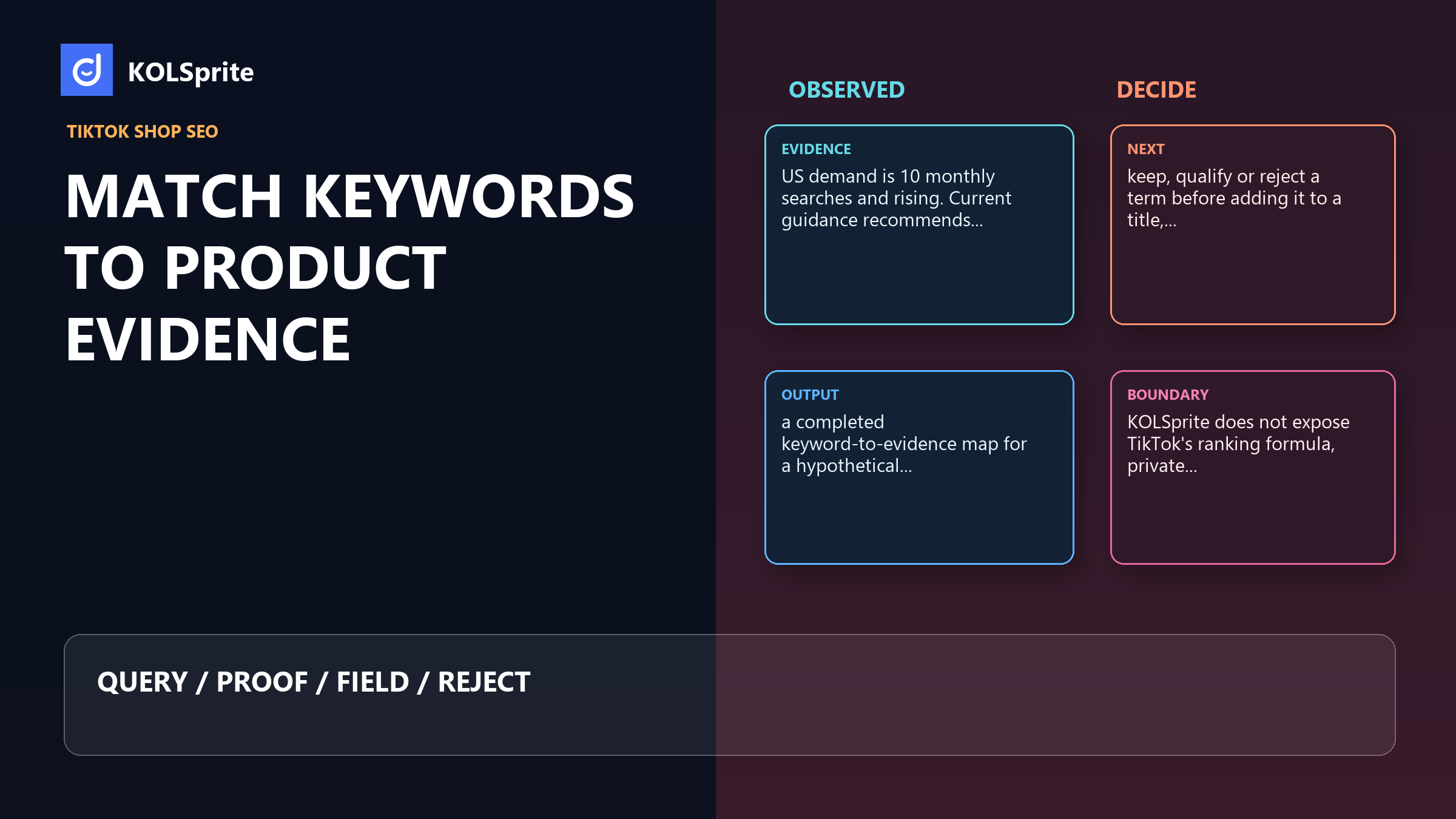
Use TikTok Shop SEO to connect search language to product evidence, not to stretch a listing toward every related query. Keep a term when the page can answer its implied question, qualify it when a precise modifier is needed, and reject it when the product cannot support the promise behind it.
Consider a phrase such as “reading light for bed.” It is not merely a string to insert into a title. It suggests a use setting, a product type, and a question about whether light can be directed without disrupting a shared space. A rechargeable book light may be relevant, but only if the listing can accurately explain how it attaches, where it is intended to be used, and what the buyer receives.
A vague keyword strategy assumes relevance is enough. A defensible strategy asks whether the seller can show the product meeting the expectation it creates. That protects the listing from irrelevant traffic and protects the shopper from landing on a page that silently changes the meaning of the query.
Current TikTok Shop guidance recommends using Seller Center keyword data and placing relevant language naturally in accurate titles and descriptions. That advice is useful because it directs sellers toward their own search data. It does not provide a ranking formula, a reason to repeat a term, or a promise that a phrase will bring traffic.
Take the raw phrase list out of the listing editor. The map needs four columns: the shopper question, the product fact, the visible evidence, and the decision. It turns a word list into a reviewable record. It also makes it easier for product, creative, and operations teammates to see why a popular phrase may not belong on the page.
A hypothetical rechargeable book light makes the method concrete. “Rechargeable book light” can be kept if the product is rechargeable and the listing can show the item and explain the included charging arrangement using verified facts. “Clip-on reading light” can be kept only when the clip is part of the product and an image or clear description shows that form. “Eye-safe reading light” should be rejected unless the seller has product-specific support for the claim and knows it is appropriate to make.
The map does not need to be large. Ten candidate terms reviewed carefully are more useful than a hundred phrases that receive the same automatic answer. It gives each word a place to earn.
Add one more test before you mark a term keep. Ask a teammate to read the phrase without seeing your product. Have them say what item, use, and result they expect. Then show the listing facts. A gap between those two answers is useful. It may mean the term needs a clear modifier. It may mean the page needs better proof. It may also mean the term belongs to a different product.
For the book light, “portable reading light” may sound safe. Yet one shopper may expect a clip, while another may expect a lamp that stands on a table. The product form must settle that gap. A phrase such as “clip-on book light” gives a clearer picture when the clip is real and shown. The map helps the team choose the clearer term for the right reason.
Keep: “rechargeable book light” | question: does it recharge? | fact: verified rechargeable power feature | evidence: product photo and verified charging details | placement: title or description.
Qualify: “clip-on reading light” | question: does it attach to a book? | fact: verified clip | evidence: image showing the clip in use | placement: description if the title already identifies the product.
Reject: “sleep-safe light” | question: will it protect sleep? | no supported product-specific evidence supplied | placement: nowhere.
Review rule: no phrase enters the page until its expectation, fact, and evidence are written together.
Register for KOLSprite and claim a three-day trial of the web product. MCP access is sold separately.
Register and claim a three-day trial
Not every rejected term fails for the same reason. First, reject a phrase when it names a product you do not sell. A book light is not automatically a desk lamp, a nursery light, or a travel lantern. Second, reject a phrase when it implies a result you cannot prove. “Pain-relief light” and “guaranteed sleep aid” are not harmless variants of a product name. Third, reject a phrase when it invites the wrong comparison set. A shopper looking for an outlet-powered lamp may not be well served by a rechargeable clip light even if both products create illumination.
Qualification is different. A term may be relevant but too broad without a modifier. “Reading light” can become a natural descriptive phrase when the title and images establish that it is a compact clip-on book light. Do not use modifiers as camouflage. Use them to keep the phrase aligned with what the product actually is.
This is why a skeptical editor is useful. The question is not “Can we plausibly include this word?” It is “Would a shopper be surprised by the offer after arriving through this word?” Surprise is a signal that the map needs a different decision.
Write the rejection reason in plain words. “Wrong product” means the phrase names another item. “Missing proof” means the item may fit the phrase, but the seller cannot yet support it. “Wrong comparison” means the phrase places the item beside products that solve a different job. These labels help the team act. The product owner can supply proof. The search editor can add a modifier. Or the team can drop the term and avoid a poor match.
Do not score a rejected term by its search demand alone. Strong demand can make a mismatch more costly because more of the wrong shoppers may see the page. The map is a quality filter before it is a placement plan.
After a term passes the evidence test, decide where it belongs. Put the product identity and its key form in the title. Use the description for questions a short title cannot answer. It can explain what is included, how a feature is used, or what an option changes. Use the search-term fields available in your Seller Center workflow for accurate, relevant language. Do not turn the visible copy into a list.
Placement should change the reader's understanding, not merely the page's density. A phrase that only works when surrounded by explanation probably belongs in a sentence, not a title. A term that describes the exact purchasable item may belong near the front of the title. Read the field aloud with the product in view. If the phrase sounds like it could describe a different item, it needs a qualifier or a different location.
Check the whole page after placement. The title, images, descriptions, category, variation labels, and price should all describe the same offer. Search language is not a separate layer above product truth. It is one way buyers find that truth.
Make one clean copy pass after the fields are filled. Remove repeated phrases that add no meaning. Replace a long term with a shorter product name when the shopper already has enough context. Keep key details close to the claim they support. This pass is not about using fewer keywords at any cost. It is about making the page sound like a clear seller wrote it for a person.
Join the KOLSprite Discord to discuss the question behind your next test.
 +
+
Join the KOLSprite Discord community
Sellers can learn from the language that appears in public product and video examples, especially when a raw keyword list lacks buyer context. KOLSprite can help inspect a bounded set of public product and video language, then organize a source-linked note for review. That is a research aid, not a way to import another seller's promises.
Start with a seller-owned keyword list and verified product facts. Ask a narrow question, such as which words public examples use to identify a clip-on reading light. Use KOLSprite to inspect public language, separate observations from unverified claims, and feed only the observations into the keyword-to-evidence map. Seller Center remains the source for the seller's own search data.
KOLSprite does not expose TikTok's ranking formula, private keyword performance, or guaranteed search gains. It does not validate a product claim. MCP is a separately paid product, not part of Plus or Pro membership and not a free-trial benefit.
Public language can reveal a vocabulary problem. It cannot solve the evidence problem. If competitors call an item “sleep friendly,” record that as a phrase seen in the market, then return to the map. Unless your product record supports the expectation, the correct decision is still reject.
TikTok Shop recommends using Seller Center keyword data and natural, relevant language in accurate titles and descriptions. Read the source: SEO & Discovery: Tips to Boost Visibility and Sales.
Scope: keyword relevance and natural listing language. Market: US. Access date: September 7, 2026. Sample: one current Seller Center University lesson. Cleaning: only explicit platform guidance was retained. Limit: this is not a ranking formula, forecast, or proof that a keyword will improve visibility.
The cleanest record is brief: phrase, question, fact, evidence, decision, field. When someone asks why a term was removed, the answer should be visible without reopening a dozen tabs. That clarity makes future updates easier when product facts, photos, or search data change.
Review the map whenever the product changes, a variation is added, or Seller Center data points to a new term worth considering. Do not treat a keyword decision as permanent simply because it was once placed in a title. The page should keep matching the current offer.
For each review, keep, qualify, or reject the term in writing. A keep decision needs a product fact and visible evidence. A qualify decision names the modifier or page context that prevents a misleading reading. A reject decision names the mismatch. That is enough structure to make search work accountable without turning it into a reporting exercise.
For broader research, start with a TikTok SEO tool workflow. Use TikTok comment analysis to study buyer wording. Then connect confirmed language to a TikTok content strategy. Close the review by dating the map and naming its owner. That leaves the next editor a useful record, not a mystery list of words.
Latest Articles

As an essential, data-driven toolkit for TikTok influencers and marketers, KOLSprite provides powerful features for effortless creator discovery, trending content identification, and actionable real-time insights.
It empowers users to make smarter decisions and significantly boosts their TikTok business.

 Refer & Earn