 +
+
More creator invites can feel like progress because the action is easy to see. But an invite only asks a creator to inspect an offer. It cannot make that offer easy to explain, safe to sample, or worth the work. When the offer is weak, a larger list just produces more noise.
A TikTok Shop affiliate program should check the offer before expanding outreach. Review the unit math, proof, sample risk, and creator fit. Repair the first weak part. Then send a smaller batch with a clear reason to accept.
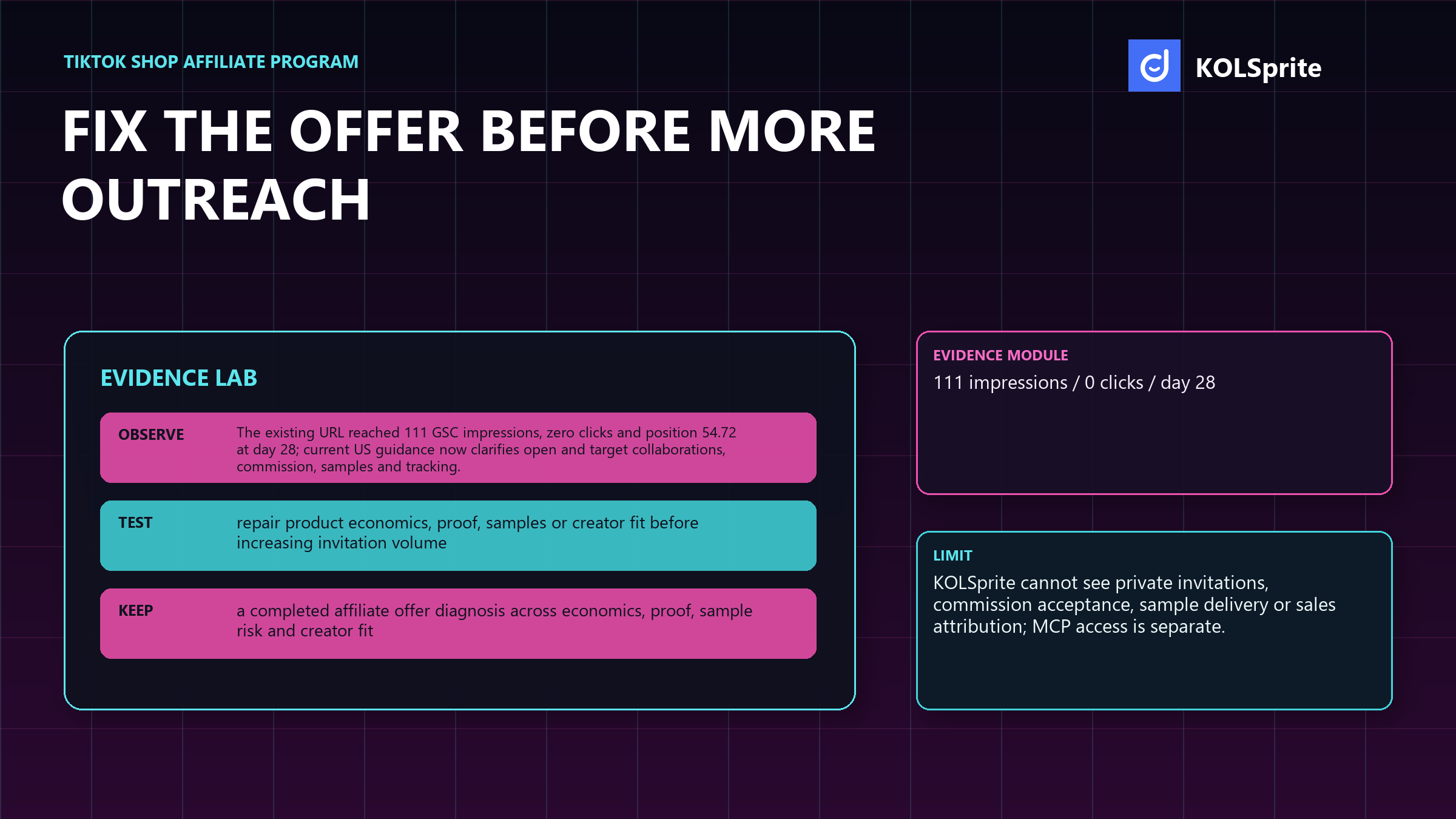
At the 28-day review, the existing page had 111 Google Search Console impressions, zero clicks, and an average position of 54.72. That is a dated visibility signal, not a diagnosis of affiliate performance. It says the page has not yet earned much search attention. It does not say creators rejected the offer, that commission is too low, or that a product cannot sell.
The useful response is to inspect the offer, not set a larger outreach quota. A creator needs a product story that is easy to explain. The reward must make sense, the sample must feel manageable, and the product must fit the creator's work. If any part is unclear, more invites only spread the doubt.
The existing URL recorded 111 impressions, zero clicks, and average position 54.72 at the 28-day review.
Scope: one existing article URL. Market: US English search property. Access date: September 4, 2026. Sample: one 28-day GSC window. Cleaning: URL-level impressions, clicks, and position retained. Limit: no private affiliate response, sales attribution, or future ranking claim.
Use four questions in order. Are the economics clear to the seller and meaningful for the creator category? Is there a proof scene that explains the product fast? What could make the sample hard to receive, use, or trust? Does the creator’s public work have a natural place for this product?
These questions are related but not interchangeable. A generous commission cannot repair a product that has no visible use case. A polished product video cannot repair a sample experience that is hard to trust. A well-matched creator cannot turn an unclear offer into a durable recommendation. The first weak part sets the repair order.
Current US Seller Center guidance separates open and target programs, commission settings, samples, creator outreach, and result tracking. TikTok Shop's guide explains these options. Its sample guide covers the sample choices. Neither source can prove creator fit, margin, response, or future GMV for one offer.
Register for KOLSprite and claim a three-day trial of the web product. MCP access is sold separately.
Register and claim a three-day trial
| Offer part | Diagnostic question | Repair before outreach | Do not infer |
|---|---|---|---|
| Economics | Can the seller explain the commission and product value honestly? | Set a workable commission and confirm internal unit economics. | That a rate alone will motivate the right creator. |
| Proof | What can a creator show in one credible scene? | Prepare a product story, use case, and claim-reviewed proof. | That a feature list is a creator brief. |
| Sample risk | What could make a sample hard to receive, use, or trust? | Fix delivery, setup, instructions, or support gaps. | That a shipped sample equals an endorsed product. |
| Creator fit | Where does this product fit naturally in the creator’s public work? | Define the audience context and a narrow outreach reason. | That follower count proves fit or sales. |
Fill the table before building the next list. The output is not a score. It is a repair sequence. If proof is the first weak part, the team should fix the product story before researching more creators. If sample risk is the first weak part, product operations owns the next action, not affiliate outreach.
Work from left to right, but stop at the first real failure. If the commission does not fit the unit math, a new creator list is too early. If the math works but the product takes a minute to explain, build the proof scene. If the scene is clear but the sample arrives late or lacks useful instructions, fix that path next.
Only review creator fit after those basics hold. Fit is more than a shared category word. A creator should have a believable setting for the product and an audience reason to care. Write that reason in one sentence. If the sentence could be sent to every creator in the category, it is still too broad.
Give each failed row one owner and one proof of repair. Finance can confirm the commission range. The product lead can approve the claim and demo. Operations can test the sample path. The affiliate lead can then define the creator context. This order turns a vague concern into work the team can finish.
Creators do not need a slogan. They need a plausible moment of use. Write one sentence that connects the product, the buyer’s situation, and the proof scene. Then write one sentence that keeps the claim in bounds. For example, a kitchen-storage product might be introduced through a weekday packing moment, followed by a specific demonstration of how the container closes. It should not promise that every meal stays fresh or every buyer saves time.
This work is often mistaken for creator management because it appears just before an invitation. It is product-offer work. The creator list should be the last part of the chain, not the first. For broader context on the operating plan, read TikTok influencer marketing.
Test the explanation on someone who did not write it. Show the product, the use scene, and the bounded claim. Ask that person to repeat the offer in plain words. If the reply turns into a feature list or an unsupported promise, the brief is not ready. Fix the offer before asking a creator to do that work in public.
An open program is useful when the offer is ready for broad discovery and the seller can support more creator interest. A target program is useful when the product has a clear context and the seller can explain why a certain creator fits. The choice should follow the offer check, not replace it.
Suppose the offer diagnosis reveals a clear packing-station proof scene but uncertain creator fit. A target batch may be appropriate because the seller can seek creators who already show order packing, small-business routines, or shipping organization. Suppose the offer still lacks a clear proof scene. Neither open nor target outreach fixes that. The team should return to the product story first.
Use open collaboration when the offer can be understood without a custom pitch and the seller can handle broad sample interest. Use target collaboration when the reason for fit is narrow and worth stating. In both cases, set the commission and sample terms in Seller Center. Keep the internal repair notes outside the invitation.
Do not treat the program type as a quality score. Open is not careless by default. Target is not precise by default. The choice is sound only when it matches the offer, the support capacity, and the fit question found in the review.
Once a real fit question remains, use KOLSprite web research to compare public creator and product context, then attach a narrow creator-review brief to the repaired offer. The public review should help a seller see visible context, not automate the invitation decision.
KOLSprite cannot see private invitations, commission acceptance, sample delivery, or sales attribution. Seller Center remains the place to configure collaborations and track results, and MCP access is separately paid.
Join the KOLSprite Discord to discuss the question behind your next test.
 +
+
Join the KOLSprite Discord community
A program needs a stop rule as much as it needs an invite message. Stop expanding the list while the offer is changing. Stop if the sample path is not ready or the same vague pitch goes to every creator. The rule protects creators from weak pitches. It also stops the seller from judging a muddled batch.
Review the first batch for operational facts the team can act on: Was the product description clear? Did the sample process create avoidable questions? Did the selected creators actually have the public context the brief assumed? Those observations may lead to a repair. They should not be inflated into a claim that a creator category will or will not produce sales.
Set the review date before sending. On that date, choose one action: repair the offer again, refine the fit rule, or release the next bounded batch. Do not add names while the review is open. A fixed pause gives the team a clean set of outreach facts and prevents volume from hiding the same weak offer.
Public creator and product evidence can be valuable after the offer has a defined job. It can help a seller compare visible content settings, product demonstrations, and category language. The TikTok creator analytics guide can help organize that review around product-linked context rather than broad popularity.
It cannot reveal the private facts that decide the unit math. Those include accepted invites, agreed terms, sample experience, the path to a sale, returns, and margin. Those facts belong to the seller's own systems. Public research is a screening aid, not a way to assign credit for sales.
Fix what the creator is being asked to sell before asking more creators. Put the completed diagnosis table in the outreach meeting. Each weak row needs an owner, proof of repair, and a review date. The stop condition stays visible beside it.
Mark the batch “go” only when the unit math works, the proof scene is claim-safe, the sample path is ready, and the fit reason is clear. Mark it “no-go” when one fact is missing. A no-go sends the offer back to its owner. It does not send the affiliate team out for more names.
After a go decision, the TikTok creator shortlist framework can support the bounded list. A TikTok Shop affiliate program moves when the offer gives the right creator a clear reason to look closer. The closing output here is a signed release gate for the next batch, not another invitation target.
Latest Articles
As an essential, data-driven toolkit for TikTok influencers and marketers, KOLSprite provides powerful features for effortless creator discovery, trending content identification, and actionable real-time insights.
It empowers users to make smarter decisions and significantly boosts their TikTok business.

 Refer & Earn